
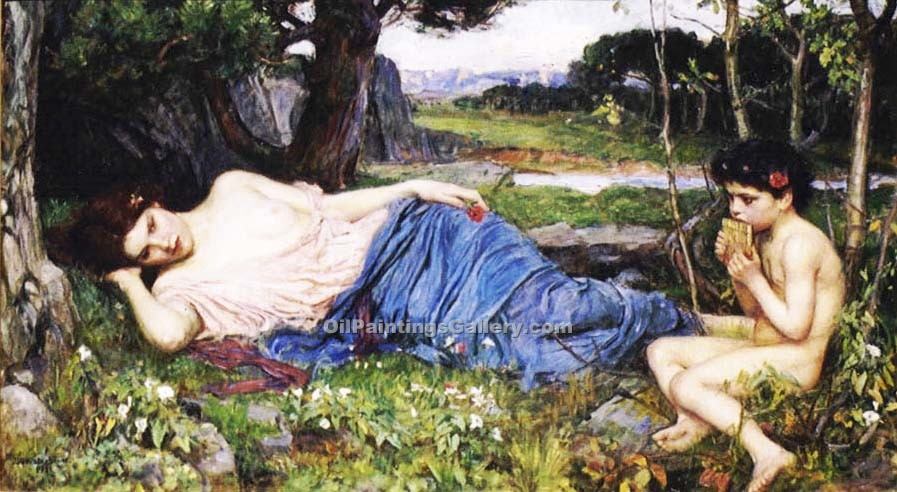
Landscape art shows scenery like mountains, valleys, trees, rivers, and forests. Sky is almost always included in the view, and weather usually is an element of the composition.
The word landscape is from the Dutch, landschap meaning a sheaf, a patch of cultivated ground. The word entered the English vocabulary of the connoisseur in the late 17th century.
Early in the fifteenth century, landscape painting was established as a genre in Europe, as a setting for human activity, often expressed in a religious subject, such as the themes of the Rest on the Flight into Egypt, the Journey of the Magi, or Saint Jerome in the Desert.
In Europe, as John Ruskin realized, and Sir Kenneth Clark brought to view, landscape painting was the "chief artistic creation of the nineteenth century", with the result that in the following period people were "apt to assume that the appreciation of natural beauty and the painting of landscape is a normal and enduring part of our spiritual activity" In Clark's analysis, underlying European ways to convert the complexity of landscape to an idea were four fundamental approaches: by the acceptance of descriptive symbols, by curiosity about the facts of nature, by the creation of fantasy to allay deep-rooted fears of nature and by the belief in a Golden Age of harmony and order, which might be retrieved.
Can't find the painting you are looking for? click here
Our customers approve their painting as painted for them prior to its shipping. This ensures that our customers are fully satisfied with their purchase.
We are the only online-art website to offer a 90-day money back guarantee for all orders.